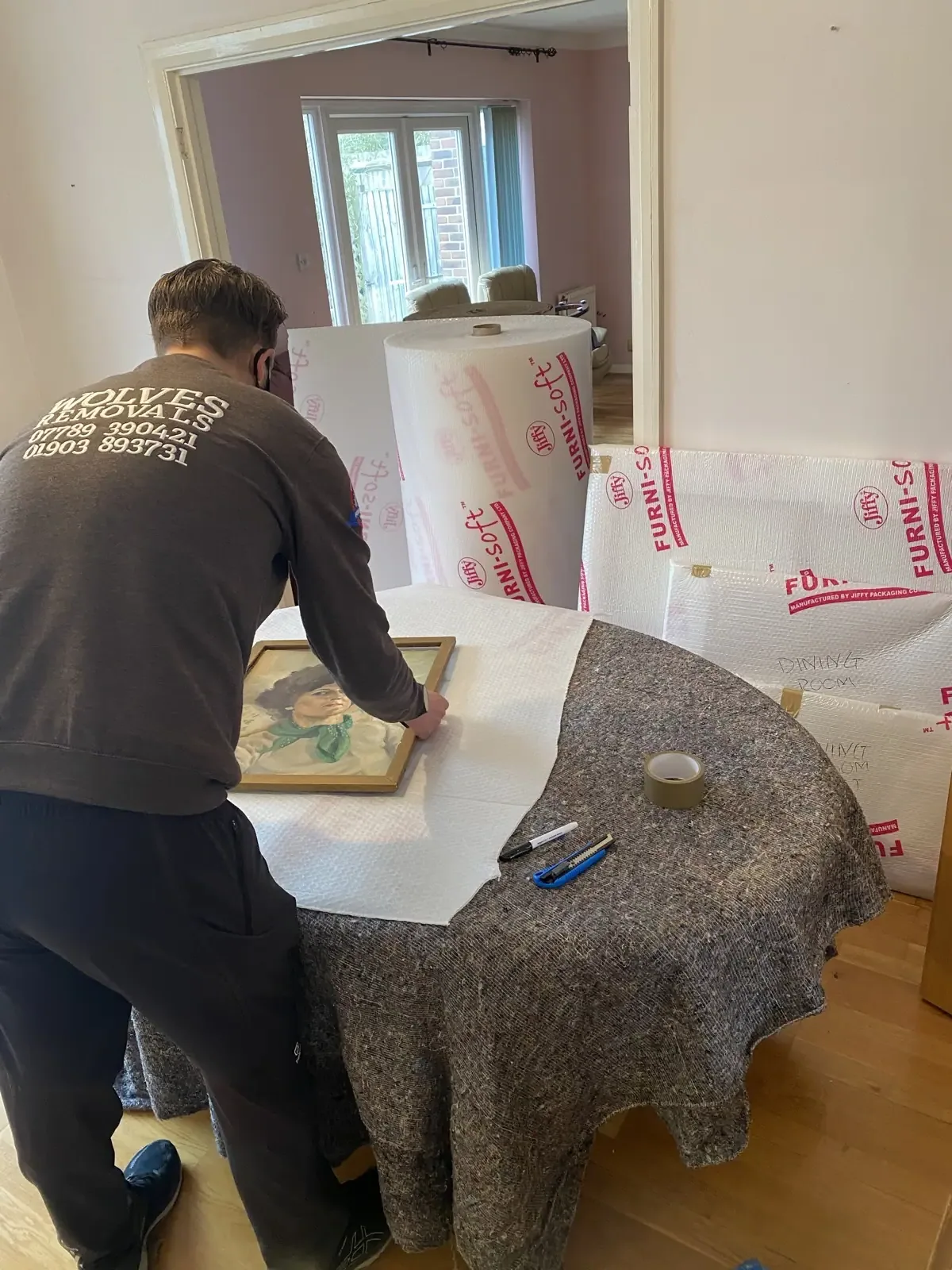
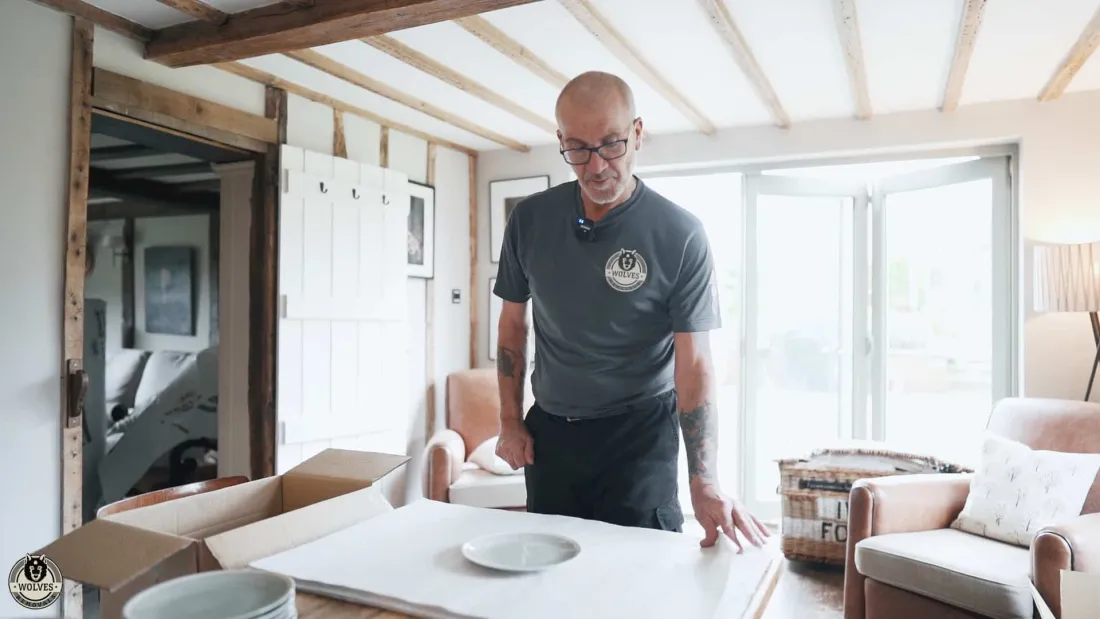
How to Move a Grandfather Clock
How to move a grandfather clock without breaking it: the parts that come off and why, the clock you have, how the case travels, and how to get it ticking evenly again at the new home.

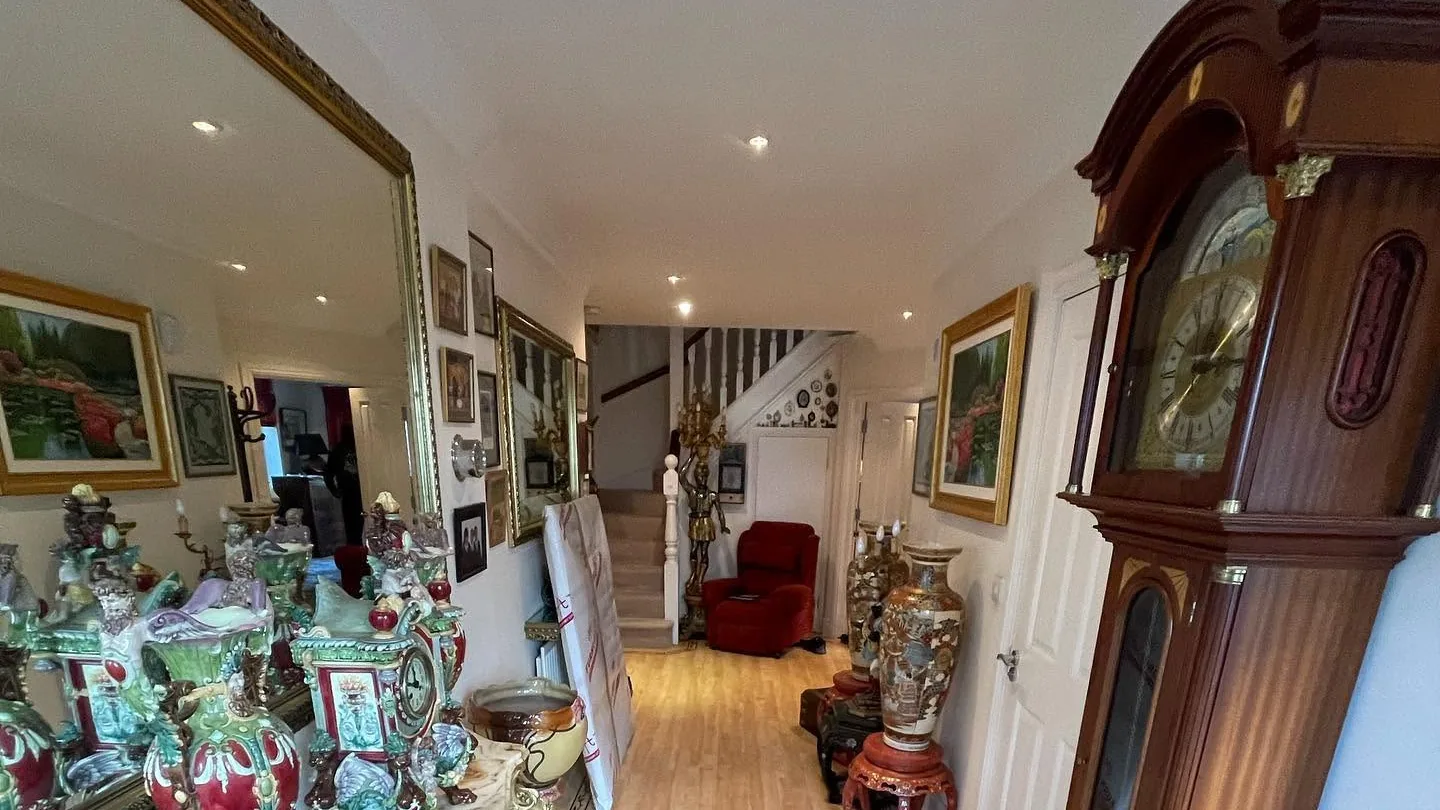
To move a grandfather clock, take it apart first: the pendulum and the weights come off and travel as separate, padded parts, and the case moves upright. The Canadian Conservation Institute lists clocks with loose mechanical parts among the objects with high sensitivity to shock and vibration.
The quick answer
Before it moves: Pendulum off, so nothing hangs on the suspension spring
Every weight: Weights labelled, each with the place it came from
How we move it: Upright, padded, strapped, with nothing loose inside
At the new home: Fixed and in beat, an even tick and tock
At the other end, the clock needs fixing to the wall and setting in beat before it will run well. Moving house in Sussex and would rather not do this yourself? We move grandfather clocks as part of a house removal: ask for a free quote.
Know the Parts Before Anything Comes Off
A grandfather clock, or longcase clock, is a tall wooden case built around a pendulum. Most have a seconds pendulum, roughly a metre long, swinging inside the trunk.
The parts of a grandfather clock
-
Hood: the top section, with a glazed door over the dial. Older hoods lift up or off; later ones slide off.
-
Finials: the ornaments on top of the hood, often one to three.
-
Movement: the brass and steel works behind the dial, screwed to the seatboard.
-
Seatboard: sits at the top of the trunk and carries the movement, dial, pendulum and weights.
-
Trunk: the tall middle section. The pendulum and weights hang inside it, behind the trunk door.
-
Lenticle: a small glazed window, usually in the trunk door, where you can see the pendulum bob. Not every clock has one.
-
Base and plinth: the bottom of the case.
Drawing not to scale; the dashed parts sit inside the case. Sources: the V&A and Science Museum Group catalogues.
One of the most delicate parts is small and hidden. The pendulum hangs from a thin steel spring at the back of the movement.
Where the pendulum hangs
-
Suspension spring: a short ribbon of steel. The pendulum hangs from it, and its top is clamped and hangs from the pendulum cock on the back of the movement.
-
Crutch: an arm on the back of the movement whose lower end drives the pendulum rod, through a slot in the rod or with two fingers either side of it. It is not fixed to the rod.
-
Why it matters: in large clocks the spring occasionally breaks close to its clamps, and a V&A record notes one that broke when a movement was taken out.
Drawing not to scale. Sources: F. J. Britten’s period horology handbook, the V&A and the NAWCC encyclopedia.
Which Clock Do You Have?
Count the weights and the winding holes before you start. Together they tell you which kind of clock you have and how many weights to label.
Which grandfather clock do you have?
30-hour
Wound daily.
-
Often one weight on an endless chain
-
Usually no winding holes, though some have false keyholes, so count the weights
Eight-day
Wound weekly.
-
Usually two weights, for timekeeping and striking
-
Usually two winding holes in the dial, turned with a crank key
Three-train chiming
Three weights.
-
Three weights and three winding holes
-
The chiming weight is usually substantial
Sources: the V&A catalogue, Icon and Paul Hasluck’s 1889 clock-repair manual.
Grandfather clocks in the V&A collection
168–297 cm tall, across 41 longcase clocks
228 cm median height: measure ceilings and stairs
3.3–12 kg each, across 62 weighed clock weights
17 of 22 two-weight clocks have a pair within 0.5 kg of each other
Our own analysis of the height and weight fields in V&A catalogue records, October 2026. Museum clocks may run grander than most; the figures are ours, not the museum’s.
The weights in a pair are often close in weight, so never guess where one goes by its size. Put each back where it came from.
How to Take a Grandfather Clock Apart
In short: the hood, the pendulum and each weight come off, and every weight is labelled with where it hung. The movement is a clockmaker’s job: on our moves, a clockmaker always takes it out.
What comes off, and how the case travels
-
Hood: some clock restorers take it off first.
-
Pendulum: off before the case moves, and packed on its own.
-
Weights: off one at a time, each tagged with the place it came from.
-
Case: moves upright, padded and strapped.
Drawing not to scale. Restorer practice, the Canadian Conservation Institute and Museums Galleries Scotland; the case line is how we move it.
Dismantling a grandfather clock for a move
-
Before anything comes off:
Measure the route. Most grandfather clocks stand 1.8 to 2.3 metres, Britannica says, and some are far taller. Check ceilings, stairs and turns at the new home too.
-
The hood:
Hood off. Some clock restorers take the hood off first, with one person steadying the movement while the pendulum and weights come off, or the movement and dial can fall forward.
-
The pendulum:
Pendulum off. Some clock restorers say that with the pendulum off, there is no weight on the suspension spring to twist or break it. Keep your hands off the dial: Icon warns that moisture from hands is corrosive.
-
Weights and lines:
Weights off, one at a time. Label each one with the place it came from. Restorers disagree on whether to let the clock run down first; either way, keep each line from tangling or slipping off its pulley.
-
The movement:
The movement: a clockmaker’s job. When we move a grandfather clock, a clockmaker always takes the movement out, never our crew. Some clock restorers say an old English longcase should have its movement and dial taken out before transport, because the case was not built to hold them fixed.
We found no museum or conservation body that publishes a moving order for clocks. These steps follow practice reported by clock restorers, with Icon, Britannica, Museums Galleries Scotland and the Canadian Conservation Institute.
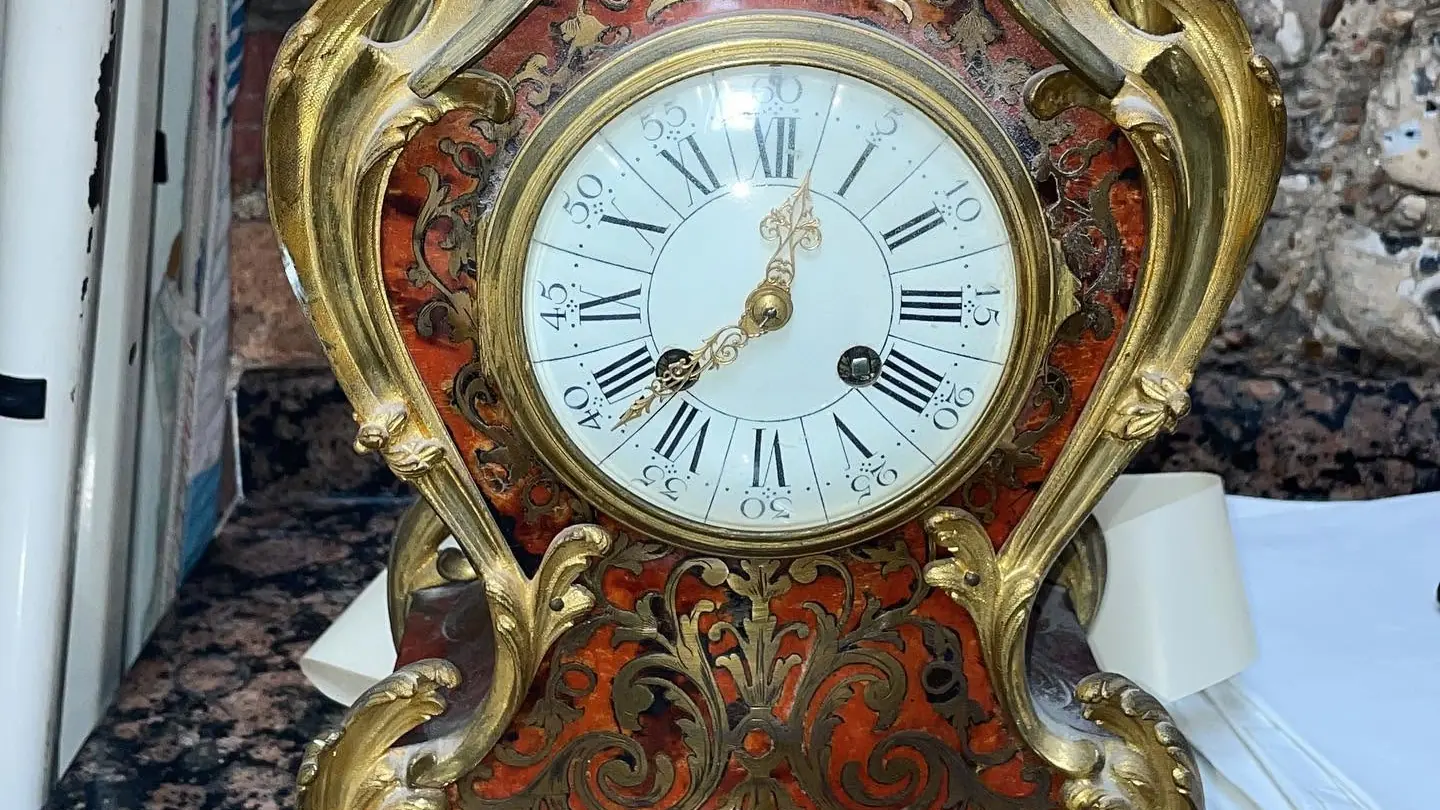
Many thirty-hour clocks run on an endless chain over spiked pulleys. Some clock restorers tie a chain up under the seatboard so it can’t slip off its wheels on the journey.
Packing the parts
Do: Pack the pendulum and each weight as separate, padded items.
Don’t: Leave weights or the pendulum loose inside the case.
Do: Bag and label small parts, or tie them on with cotton tape.
Don’t: Put tape on the wood, the finish or the dial.
Do: Hold the doors shut with cotton tape round the wrapping.
Don’t: Let the hood or trunk door swing open in transit.
From the Canadian Conservation Institute, Museums Galleries Scotland, the US National Park Service and Icon. Some clock restorers also put card or foam over the ends of chime rods so they cannot bounce.
Transporting the Case: Upright or Lying Down?
Our guide to wrapping antique furniture covers the padding, and our guide to moving antique furniture covers lifting and humidity.
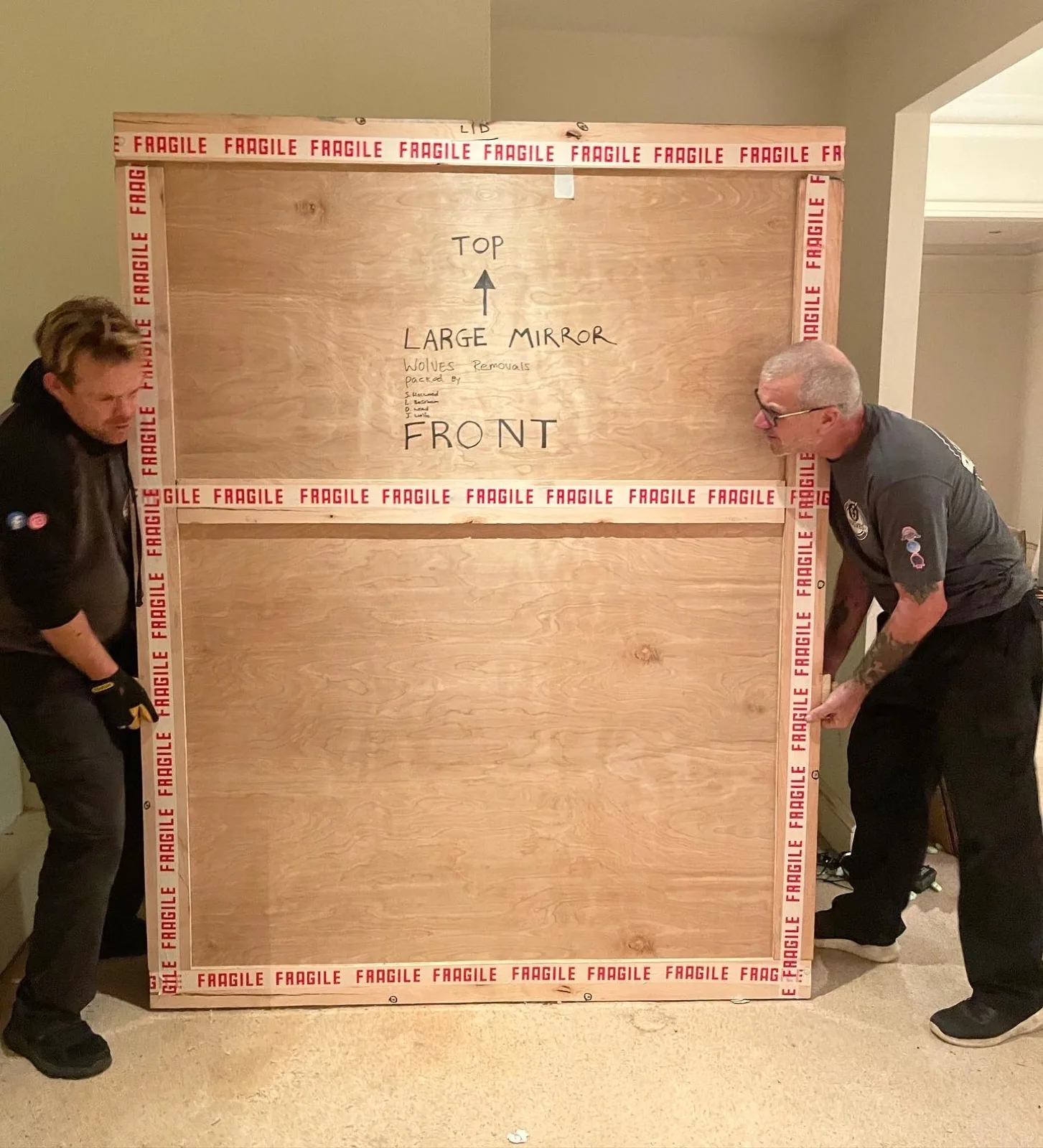
How we move the case
-
A clockmaker takes the movement out, never our crew.
-
Upright, once the pendulum and weights are out.
-
Padded, and strapped top and bottom.
-
Two people, with the route measured first.
How we move a grandfather clock case.
What restorers say
No fixed rule.
-
Clock restorers differ on upright or on its back once everything loose is out
-
One restorer warns that a mirror-backed case should not lie on its back
We found no museum or conservation guidance written for clocks. Practice reported by clock restorers on a clock collectors’ forum. General furniture guidance from the American Institute for Conservation lays case furniture on its back in a van, but does not mention clocks.
Setting Up a Grandfather Clock After Moving
At the new home, check the case stands level, fix it to the wall, then hang the weights and the pendulum and listen for an even tick and tock.
At the new home
-
Before the parts go back:
Check it stands level and firm. Away from any heat source, such as a radiator, a working fire or strong sunlight: Icon says heat can damage the case and the movement.
-
Fixing it:
Fix the case to the wall. Icon says a longcase clock must be fixed securely to a wall, for safety and so it runs properly.
-
Putting it back:
Weights, then pendulum. A period repair manual says to hang the weights and wind carefully, checking each line runs on its barrel, then put the pendulum on.
-
Starting it:
Listen for the beat. An even tick and tock. If it stops or the tick is uneven, call a clock restorer.
-
Setting the time:
Minute hand only. Move it gently and let the clock finish striking. Never turn the hands of a striking clock backwards without advice.
-
Winding:
Wind every weight. The strike included: Icon does not recommend leaving the strike unwound to silence a clock.
Sources: Icon and a period clock-repair manual.
In beat: an even tick and tock
-
In beat: the tick comes when the pendulum has swung as far to one side as the tock does to the other, so the sounds are evenly spaced.
-
Out of beat: the ticks come in uneven pairs, and the clock either won’t run or runs for a while and stops.
-
Your part: stand the case level and fix it firmly to the wall.
-
A clock restorer’s part: if it is still uneven, adjusting the crutch is restorer work, not a job for the move.
Drawing not to scale. Sources: a period clock-repair manual, the NAWCC encyclopedia and Icon.
Faster or slower: the rating nut
-
Stop the pendulum and support it so it can’t twist, then turn the nut under the bob.
-
To the right raises the bob and the clock runs faster; to the left lowers it and the clock runs slower.
-
Make half-turn adjustments and wait two or three days between them.
-
When you restart it, swing the pendulum only about a centimetre to one side.
Source: Icon’s guidance on caring for clocks.
When to Call a Clock Restorer, and When to Call Us
A mercury pendulum
Restorer job.
-
A jar of mercury as the bob, found mainly on precision regulator clocks
-
Moving one is a job for a clock restorer
-
Never vacuum spilled mercury or use a broom on it
-
For a larger spill, contact your council’s environmental health team
Call a clock restorer if
After the move.
-
It stops or keeps erratic time after the move
-
It has stood stopped for more than about a month
-
It is due a service: Icon suggests examining and re-oiling every three years
Sources: UKHSA, the US Environmental Protection Agency, the Canadian Conservation Institute and Icon. Icon’s Find a Conservator directory lists accredited horological conservators.
For grandfather clock removals, we are a LAPADA Approved Service Provider (LAPADA is the Association of Art & Antiques Dealers), and care for antiques, grandfather clocks included, is part of our standard house removals price. For larger collections, see specialised antiques moving; for a piano, see how to move a piano.
Moving a grandfather clock?
Tell us about the clock, its height and how many weights it has, at a free video or in-home survey, and we’ll measure the route and plan the move around it.
The Wolves Removals Team
Family-run removals · Ashington, West Sussex
We have moved families and businesses across West and East Sussex, Surrey, Hampshire and Kent since 2016, from our Ashington base. We are fully insured, Checkatrade-verified and a LAPADA Approved Service Provider for antiques and fine art. More about us, or read our reviews.
How to Move a Grandfather Clock — FAQs
Some clock restorers do, once everything loose is out; others keep it upright. We found no museum or conservation guidance written for clocks. We move the case upright, padded and strapped, once the pendulum and weights are out. One restorer warns that a mirror-backed case should not lie on its back.
Yes. The Canadian Conservation Institute classes clocks with loose mechanical parts as highly sensitive to shock. With the pendulum off, nothing hangs on the suspension spring. Label each weight with the place it came from and pack it separately.
A clockmaker. When we move a grandfather clock, a clockmaker always takes the movement out, never our crew. We look after the case, the padding and the move itself.
Often it is out of beat: the tick and tock are no longer evenly spaced, so it runs for a while and stops. Make sure the case is level and fixed to the wall. If it still stops, call a clock restorer.
Yes. Icon, the Institute of Conservation, says a longcase clock must be fixed securely to a wall, both for safety and so it runs properly.
Move only the minute hand, gently, and let the clock finish striking. Never turn the hands of a striking clock backwards without advice. Rather than moving the hands forward several hours, stop the clock and restart it when the time catches up.
Turn the rating nut under the pendulum bob: to the right to run faster, to the left to run slower. Icon advises half-turn adjustments, waiting two or three days between them.