Moving Antique Furniture: What Really Causes the Damage
The best way to move antique furniture without damage, based on what conservation guidance says goes wrong.

The best way to move antique furniture is to empty it, take off anything that comes off, and lift it by its frame rather than its top or arms. That sums up advice from conservation bodies including Icon (the Institute of Conservation) and the US National Park Service.
The quick answer
Lift by: The frame, low down, not the top or arms
First layer: Tissue or cotton, then a blanket or bubble wrap
Marble and glass: On edge, carried upright
Full adjustment: Days to months, for most pieces to match a new humidity
Conservation body Icon names poor handling as the greatest everyday risk to historic objects. On our dealer move, each piece was handled 11 times per van load; only the drive was hands-off. We plan those lifts at a free survey.
The best way to move an antique: six steps
-
Before the move:
Check it first. Look for loose joints, splits, lifting veneer and flaking finish, photograph any existing marks, and measure the route out.
-
Before the move:
Take off what comes off. Drawers, shelves, removable doors, and marble or glass tops. Tie doors that stay on with cotton tape, never sticky tape.
-
Before the move:
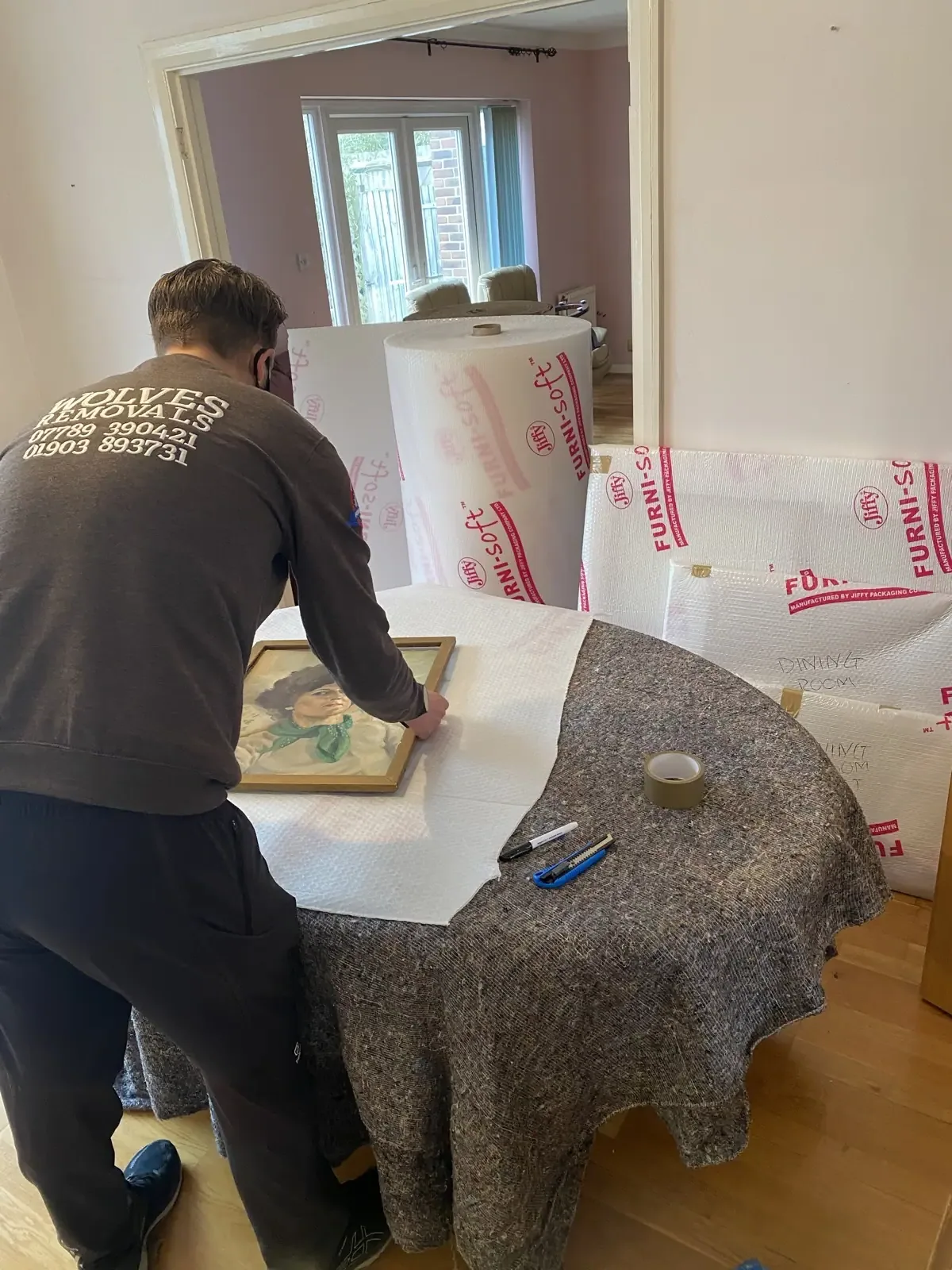
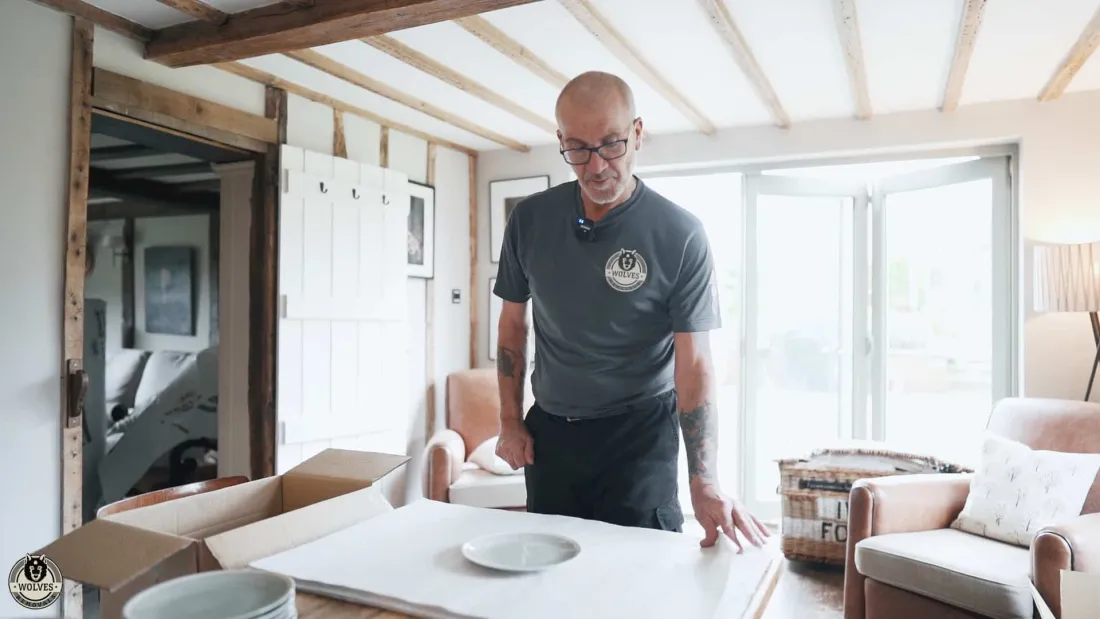
Wrap in layers. Acid-free tissue or soft cotton against the surface, then a moving blanket or bubble wrap, bubbles facing out. Tape goes on the wrapping only.
-
Moving day:
Lift, never drag. Two people or more, holding the frame low down, never the top or the arms.
-
Moving day:
Strap it in the van. Tie each piece so nothing can slide, tip or bounce.
-
At the new home:
Settle it slowly. Unwrap it away from radiators and fires, and check it over the next few weeks.
Sources: Icon, the Canadian Conservation Institute and the US National Park Service.
In the van, tie everything down. The Canadian Conservation Institute found that properly tied-down packages take shocks of roughly a 15 cm drop. Untied loads can bounce repeatedly and take far bigger knocks.
Five Ways Antiques Get Damaged
1. Lifting from the wrong place
Old furniture is strongest in its frame, so hold it low down. Never drag it: sideways pressure on legs and feet can shear them off. Most pieces need at least two people, and the US National Park Service handbook says a large sofa may need four. Health and Safety Executive guidance adds that one person should plan and lead a team lift.
Where to hold it
Hold here
-
A table by its apron (the frame under the top) or its legs
-
A chest by its bottom rail
-
A chair by its seat rails
Never here
-
A table top, which can come away
-
Chair or sofa arms
-
Protruding handles, which are often weak
Sources: the US National Park Service handbook, Icon and the American Institute for Conservation.
2. Loose parts left in place
Before it moves
Take out or tie down
Loose parts.
-
If the piece is safe to move, take out shelves, drawers and removable doors
-
Lock doors that stay on, or tie them with cotton tape or soft cotton straps, never adhesive tape
-
Tag any handles you take off, so each goes back in its original place
If a piece comes off
Keep every bit.
-
Put it in a labelled bag noting where it came from
-
Keep it with the furniture
-
Give it to a conservator rather than gluing or tacking it back
3. The wrong thing touching the surface
Wrapping, layer by layer
-
The wood. Clean the surface first, so grit isn’t pressed into it. Bare hands matter too: finger marks can become permanently etched into varnished and lacquered surfaces.
-
A soft layer against it. Acid-free tissue, washed cotton or a non-woven polyethylene sheet: soft, clean and chemically stable. Wool and jute tend to be abrasive, so keep them off the surface.
-
A blanket or bubble wrap over that. Bubble side out. Bubble wrap and some foams can leave imprints on varnished wood, lacquer and other smooth surfaces.
-
Tape and straps on the outside. Keep tape off the object and off the layer touching it.
Sources: the US National Park Service, the Canadian Conservation Institute and Icon.
When we moved an antique dealer’s stock in seven van loads, every piece travelled in full padded covers and blankets. That job is written up in our guide to how to wrap antique furniture for moving.
4. Humidity changing after the move
Wood takes in and gives off moisture as the humidity around it changes, so it swells and shrinks. Where parts are held fast by other parts, the swelling parts get crushed and the shrinking parts can crack. Icon says a fluctuating environment has the greatest potential to damage furniture, and that cracks, splits and lifting veneer can be signs of it.
An example: how much a two-foot panel could grow
Humidity:
30%→70%
Swelling:
Up to 2%
Two-foot panel:
~½ inch
Drawing not to scale. Source: the US National Park Service handbook, for a large, fast rise in humidity.
Central heating does the opposite: warming cold winter air lowers its relative humidity, so heated rooms are dry and wood shrinks.
Furniture reacts slowly. The Canadian Conservation Institute says most pieces take many days, even months, to adjust fully to a new humidity. That is why a crack can appear weeks after a move rather than on the day.
Which pieces humidity change hurts most
- Very high risk:
Metal, horn or shell inlay wider than 1 cm across the grain.
- High risk:
Veneer over corner joints, fretwork and applied ornament.
- Very vulnerable:
Veneer on drawer rails and bottom rails: as the wood shrinks it can form a raised lip that catches a drawer or a cloth and tears off.
- Medium risk:
Most 18th- and 19th-century chests of drawers and fine tables with veneer over an unbroken surface.
Sources: the Canadian Conservation Institute and the US National Park Service.
5. Gilt and fragile veneer
Gilding is gold or metal leaf laid over a chalky base called gesso. Water gilding dissolves in water; oil gilding does not readily dissolve. Even dusting slowly wears gilt away, and in very damp conditions the gesso can soften, swell and chip off the wood. Icon advises handling gilded pieces as little as possible, lifting a heavy frame from underneath its lower edge, and keeping any flakes for a conservator. Hands should not touch gilt: Icon suggests either cotton gloves or snug vinyl or latex ones. The US National Park Service handbook says not to wear gloves on fragile veneer that might snag, or on heavy pieces that need a sure grip.
Is Plastic, Bubble Wrap or Stretch Film Safe on Antiques?
Not straight onto the finish, whether bubble wrap or stretch film. Over a soft layer, for the journey itself, conservation guidance accepts it. The sources are cautious about trapped moisture: condensation after a sudden temperature drop, or a piece wrapped damp.
The caution
Written for paintings.
The US National Park Service museum handbook advises against plastic wrapping for paintings in transit. If the temperature drops sharply, condensation can form inside, and that can support mould.
When plastic is fine
With conditions.
The Canadian Conservation Institute says furniture wrapped in heavy polyethylene is shielded from weeks of very high or very low humidity. That holds as long as the piece is dry when wrapped, is not colder on one side, and isn’t kept somewhere that swings between damp and dry.
Where the sources agree, and what we do
-
Never wrap anything damp
-
Keep tissue or cotton between any plastic sheet and the surface, because moisture can condense on polythene
-
Keep wrapped pieces out of the sun and away from heat; Museums Galleries Scotland says polythene in sunlight can sweat
-
Bubble wrap is for the journey, not long-term storage
-
On our move of an antique dealer’s stock, the clear sheeting came off once each piece was in place, and anything waiting longer got a breathable cover
Marble, Glass, Mirrors and Clocks
Marble tops come off before the base moves. Icon suggests laying out battens first, so the top can be set down on its edge.
Moving a marble top
On its edge:
Do this.
Off the base and carried upright, like a sheet of glass, then set down on battens.
Flat, held at the ends:
Avoid.
A large top can break under its own weight.
The US National Park Service, Icon and the American Institute for Conservation all give the same advice.
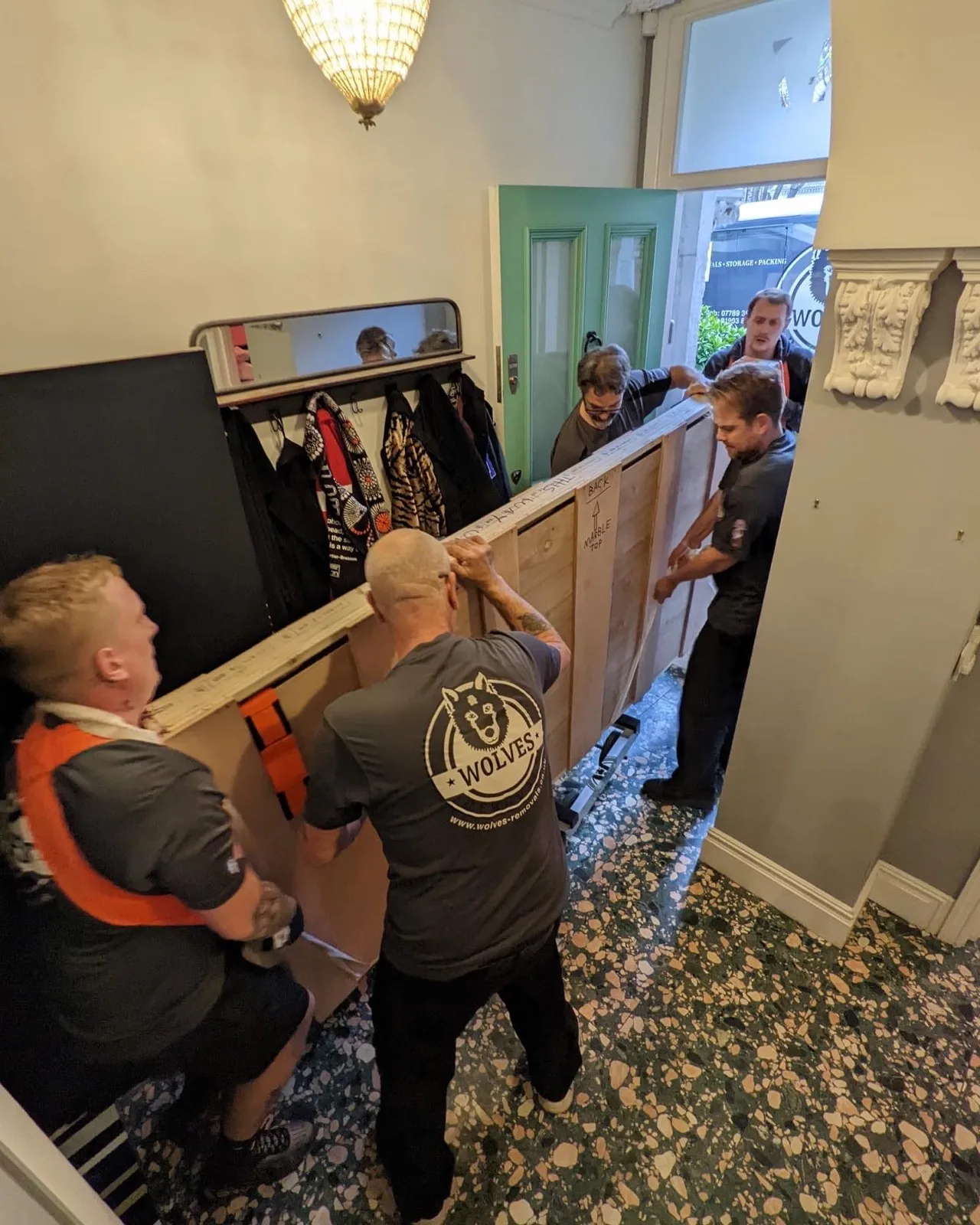
Glass, mirrors and clocks
Mirrors and glass
Upright.
-
Carry them upright, which spreads the weight and cuts the risk of cracking
-
Check the glass is secure in its frame first
-
Mirrors made before the 19th century may have a mercury-tin backing that can release mercury: handle it in disposable plastic gloves, and ask a conservator about one that looks unstable
-
Keep tape and sticky labels off decorated glass and ceramics
Clocks
At the new home.
-
Icon says a longcase clock must be fixed securely to a wall, for safety and to run properly
-
A clock that has stood stopped for more than about a month should be looked at by a professional
-
Nobody should touch the dial
-
Our guide to moving a grandfather clock covers how we pack the weights and pendulum
After the Move: Why Cracks Appear Weeks Later
Unwrap each piece in the room where it will live, and keep it away from radiators and other heat sources, where the air is very dry. English Heritage has seen some link between veneer or panel cracking and being close to a radiator. Icon suggests keeping rooms a little cooler over winter, which helps hold the humidity above 35%.
There is no single correct humidity. Respected bodies give different ranges:
Recommended relative humidity for furniture: a range of views
- Icon, furniture care page: 40–60%. Icon, 2006: a suitable range, kept stable
- Icon, environmental guidance note: 35–65%. Proven safe in a well-maintained UK building
- English Heritage, loan conditions: 35–65%. For general objects lent out, above 5°C
- Bizot museum loan guideline: 40–60%. Exhibition loans, no more than ±10% in 24 hours
- US National Park Service: 45–55%. 50% ±5%, the ideal for wood in most of the US
Museum loan figures are for exhibitions, not homes. Icon says conservation is moving towards matching the conditions a piece has lived in, rather than one fixed figure.
More important than the exact figure is avoiding big, sudden swings. Watch for new cracks, lifting veneer and loose joints in the weeks after a move.
Putting Antiques Into Storage
Storing antique furniture
Do: Raise wooden furniture on blocks: the end grain of the legs soaks up moisture from concrete, stone or brick
Don’t: Never stack furniture
Do: Keep it away from outside walls, basements and attics, where temperature and humidity swing most
Don’t: A plastic cover over a damp floor traps the damp
Do: Cover upholstery with clean cotton sheets
Don’t: Never bag a piece for long storage if it has been living above 65% humidity
From the US National Park Service and the Canadian Conservation Institute.
The Canadian Conservation Institute says clean wood needs 80 to 85% humidity before mould is likely, but dirty surfaces go mouldy sooner. English Heritage notes that clothes moths live in wool and horsehair stuffing.
Woodworm: old or active?
Old holes
Not proof.
-
Exit holes on their own
-
Dust from an old infestation falling out when a piece is moved
Active woodworm
Act on it.
-
Fresh, sharp holes
-
Fresh frass (the fine wood dust beetles leave), especially in late spring
-
Wrap the piece in plastic, move it away from other furniture and call a conservator
From English Heritage’s woodworm sheet and Icon.
English Heritage’s woodworm sheet says beetle eggs and young larvae won’t survive below 55% humidity, while Icon puts the risk highest above 70%.
Our long-term storage keeps furniture in sealed containers inside a clean, dry warehouse. Wood isn’t sealed in plastic for long periods, because that can trap condensation.
Ivory and Insurance
Some older pieces have small ivory parts, and GOV.UK uses a keyhole plate on a large piece of furniture as an example.
Ivory
Ivory Act 2018.
-
Allowed: owning it, and moving your own furniture, which is not dealing
-
You can keep the piece, give it away, leave it in a will or lend it without payment
-
Banned: dealing in ivory, which means buying, selling or hiring it
-
Some sales are exempt, so check the rules before selling
Insurance
Check your cover.
-
Home contents policies usually have a single-item limit, and items worth more may need an extra premium
-
Keep an inventory of replacement values, and recheck your cover after buying something expensive
-
An insurer may ask for receipts or recent photographs as proof
-
Our antiques service talks through a declared value for your pieces and records their condition before anything is wrapped
From GOV.UK and the Association of British Insurers.
When to Call a Conservator, and When to Call Us
Call a conservator before the move if a piece has:
Damage already there
Don’t repair it yourself.
-
Flaking paint or varnish
-
Loose veneer
-
Parts already off
A hidden risk
Get advice first.
-
Live woodworm
-
An unstable old mirror
Icon warns that amateur repairs can do more harm, and cost more, than leaving a piece alone. Its Find a Conservator directory lists accredited conservators.
For the move itself, we are a LAPADA Approved Service Provider (LAPADA is the Association of Art & Antiques Dealers). Care for antiques and fine furniture is part of our standard house removals price. For larger collections, long journeys and pieces that need a crate, see specialised antiques moving and when antiques need a crate. Inherited pieces and probate moves are covered on our antique furniture removals in West Sussex page.
Every move starts with a free video or in-home survey. Our write-up of a collection move on the Brighton seafront shows why: measure the stair and the turn at the survey, and you know before moving day which pieces won’t fit.
Moving antiques with us
Tell us about the pieces that matter at the survey, and we’ll plan the wrapping, the lift and the route around them.
The Wolves Removals Team
Family-run removals · Ashington, West Sussex
We have moved families and businesses across West and East Sussex, Surrey, Hampshire and Kent since 2016, from our Ashington base. We are fully insured, Checkatrade-verified and a LAPADA Approved Service Provider for antiques and fine art. More about us, or read our reviews.
Moving Antique Furniture: What Really Causes the Damage — FAQs
Empty it, take off loose parts and marble or glass tops, and wrap it with a soft clean layer first and a blanket or bubble wrap over that. Lift it by its frame with two or more people, strap it in the van, and keep it away from heat for the weeks after.
Not directly. Bubble wrap can leave imprints on varnished and lacquered surfaces, so conservation guidance puts acid-free tissue or soft cotton against the surface and bubble wrap over it, bubbles facing out. It is for the journey, not long-term storage.
Furniture can take days or months to adjust to a new humidity, so cracks and lifting veneer often appear after the move, not on the day. Dry air near radiators and central heating can cause it.
Yes. The Ivory Act 2018 bans dealing in ivory, which means buying, selling or hiring it. Owning it is allowed, and moving your own furniture is not dealing.
No. Care for antiques and fine furniture is part of our standard house removals price. Larger collections and pieces that need a crate can use our specialised antiques service.