How to Move a Wardrobe
To move a wardrobe, empty it, take the doors off, and measure before you take anything else apart.

If it will pass through the doorways lying down and there is room to stand it back up, move it whole. Dismantle it only when the access forces you to. Carry it with two people, and fix it back to the wall at the other end. The clearance table below does the maths.
Sources: Wolves Removals; Approved Document K; HSE INDG143; Office for Product Safety and Standards.
Should you dismantle a wardrobe, or move it whole?
Whole, if it will physically go. Dismantling is what you do when access forces it, not a default, because a flat-pack wardrobe goes back together a little looser every time.
Dismantle or move it whole? It depends how it is built
Flat-pack
Move whole if it fitsSolid or traditional
Often made to come apartModular systems
Move the frame wholeFitted
Stays with the houseHow to move a wardrobe without taking it apart
Empty it, take the doors off and carry it through lying down; width and depth decide whether it passes. But at the other end it has to be stood back up. Swinging it up from lying on its back needs clear height equal to the diagonal of its side, not just its height. Stand it up from its side instead and the width replaces the depth, so you need more height.
The clearance rule
Clear height = √(h² + d²)
- Lay it on its backSo it passes through doorways lying down.
- Tip it up about the bottom edgeThe top corner swings through an arc.
- The arc decides, not the heightIt peaks at the diagonal of the side.
Now compare a real room. For new homes, the government’s space standard sets a minimum floor-to-ceiling height of 2.3m for at least 75% of the floor area, where the council has adopted it. The London Plan asks for 2.5m in new London homes. So a 2.1m wardrobe is tight but workable in a room built to that standard, and a 2.3m one needs more than the minimum. Under a sloping ceiling, in a loft conversion or below a low beam, as on a Chichester to Salisbury cottage move, it often cannot be stood up at all. That is when a wardrobe gets carried all the way in, and then all the way out again, which is why new furniture is best built in the room it will live in.
Can you move a wardrobe on your own?
Not a tall one, and not safely. The Health and Safety Executive’s (HSE) workplace guidance gives guideline weights of about 25kg for men and 16kg for women, held close to the body at waist height. It says these are not safe limits, and that the law sets no specific weight limit. An empty wardrobe carcass is bulky, hard to grip and impossible to see over, so it is a two-person carry. Carry it rather than drag it, with the weight low and the carcass tilted back. On your own, take it apart: HSE advises making the load smaller or lighter, and dismantling does exactly that.
Before you lift it
HSE’s workplace guidance, applied to a wardrobe.
Plan the carry
On the lift
How do you dismantle a wardrobe?
Work from the outside in, bagging every fixing as it comes out. A flat-pack is usually a job for the hex key it came with.
Six steps, outside in
- Empty it completely, including the top, which is where things get forgotten.
- Doors off at the hinges, with someone holding the weight while the last screw comes out.
- Shelves and hanging rails out; most lift free.
- Ease the back panel off. It is thin and splits, and without it the carcass has no rigidity.
- Lay the carcass down before taking the frame apart. A tall empty carcass with its doors off is unstable and will go over.
- Photograph each stage, keep the instructions, and tape one bag of every screw, cam and dowel to the largest panel.
Fixings that travel loose in a box are the commonest reason, in our experience, that a wardrobe cannot be rebuilt on the first evening.
How do you move a wardrobe with mirrored or sliding doors?
Take the doors off first, whatever else you decide. A mirrored door is heavy glass, and if it swings open while the wardrobe is tilted, it can crack or tear its hinges out. Sliding doors usually lift up and out of the bottom track at a slight angle, which is easier once the wardrobe is empty. Once off, a mirrored door travels like a mirror: blanketed, taped across the face so a break stays contained, carried on edge by two people, and never laid flat where someone can put something on it.
What do you do with the clothes?
Hanging clothes go into wardrobe boxes, with a rail across the top. Everything travels on its hangers and comes out ready to hang, not folded into cartons and ironed at the other end. Do not move a wardrobe with the clothes in it. The weight sits high, and a carcass built to hold it standing still is not built to hold it tilted through a doorway.
How do you get a large wardrobe up or down the stairs?
Measure the turn at the half landing and the headroom above the flight first; those, not the stairs, are usually the problem. Building regulations guidance asks for at least 2m of headroom over new stairs. Loft conversions may have 1.9m at the centre and 1.8m at the side, and older stairs may have less. If the answer is no, that is when dismantling earns its keep. The same thinking applies to moving furniture up a spiral staircase.
How do you protect a wardrobe in transit?
Corners and top edges take every knock, so that is where the blankets go. Wrap, then strap, with the straps bearing on a blanket rather than the veneer. In the vehicle a wardrobe travels upright against a side, strapped to a rail, not on its back with the load piled on top. If plain hinged doors stay on, strap them shut, because a door that swings open in transit takes the hinge and a piece of the carcass with it.
Rebuild it, then fix it to the wall
Rebuild from your photographs, back panel square before the doors go on. Then secure it: government product safety advice says heavy furniture should be attached to the wall to avoid it tipping over. Use the wall fixing that came with the wardrobe, or one suited to your wall.
Can fitted wardrobes be moved?
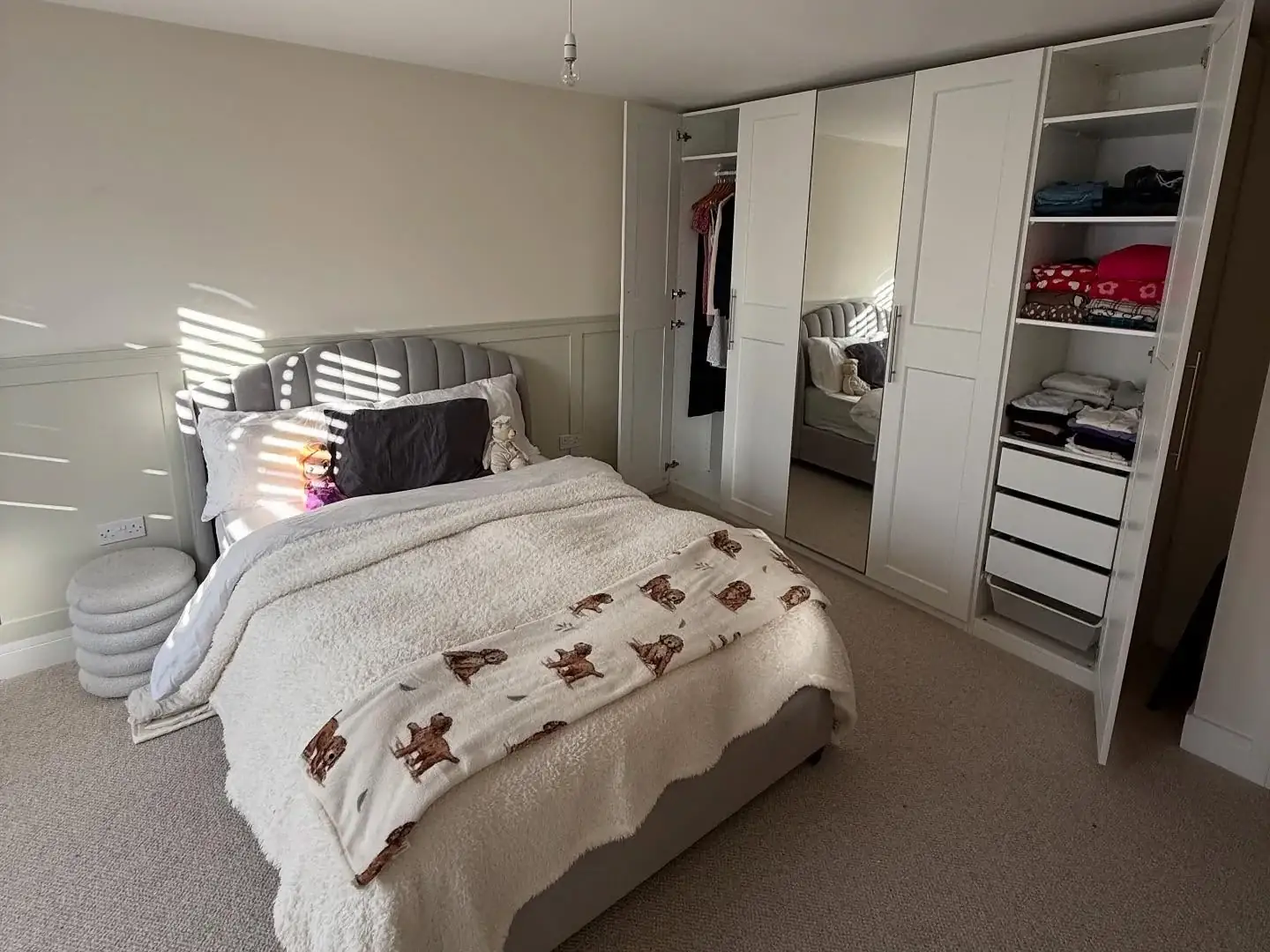
Generally not. A fitted wardrobe is cut to fit the wall, floor and often the ceiling, and it is part of the building rather than your contents; GOV.UK lists built-in wardrobes among a home’s fixtures. In a sale, agree which fixtures and fittings the offer includes. Taking one out is a carpentry job, with the walls made good afterwards, and what comes out is rarely reusable elsewhere because it was cut to that space. If you want it to come with you, agree it in the sale and book the carpentry well before moving day.
What goes wrong when moving a wardrobe?
Five avoidable mistakes
- It went in whole and would not stand up. The diagonal was never measured.
- The back panel split coming off, so the rebuilt carcass is no longer square.
- The fixings went into a box, not onto the panel, and it spent the first night in pieces.
- The mirrored door was carried flat by one person.
- It was rebuilt and never fixed back to the wall. Heavy furniture should be.
We meet the first four on jobs. All five are avoidable.
How do you get rid of an old wardrobe?
If it is not coming with you, GOV.UK says most councils will collect large items for a fee. If you pay a private business to take it away, you must check it is on the register of waste carriers; you could be fined if your waste ends up with someone not allowed to take it.
Do removal companies dismantle wardrobes?
Yes. Our crews dismantle and rebuild wardrobes as part of a household move; tell us at the survey and the time is planned and priced into your written quote, so nothing is added on the day. What a crew brings is judgement about which should come apart. A flat-pack wardrobe is usually about forty minutes to rebuild; on an Ashington to Storrington move, a wardrobe that was not flat-pack, and only went back together in one order, took three hours.
Tell us when you ask for a quote if there is a tall wardrobe, a mirrored one, or a sloping ceiling at the far end, so the access is planned in advance. Our house removals page covers what a survey looks at, and if the bedroom is coming as a whole, how to move a mattress covers the rest of it.
About this guide. Rules described apply in England. Sources: Approved Document K, the nationally described space standard, the London Plan 2021, HSE guidance INDG143, the Office for Product Safety and Standards and GOV.UK. Research method: every fact was checked twice against its linked source in October 2026; the practical advice comes from our own crews.
The Wolves Removals Team
Family-run removals · Ashington, West Sussex
We have moved families and businesses across West and East Sussex, Surrey, Hampshire and Kent since 2016, from our Ashington base. We are fully insured, Checkatrade-verified and a LAPADA Approved Service Provider for antiques and fine art. More about us, or read our reviews.
How to Move a Wardrobe — FAQs
Only if access makes you. If it passes through the doorways lying down and can be stood upright at the other end, move it whole. In our experience a flat-pack wardrobe goes back together slightly looser each time it comes apart.
Empty it, take the doors off, and measure two things: whether it passes through the openings lying down, and whether there is enough clear height to stand it up. Tipped up from its back, that height is the diagonal of its side. A 2.1m tall, 0.6m deep wardrobe needs about 2.18m.
Not safely if it is tall. HSE’s workplace guidance gives about 25kg for men and 16kg for women held close at waist height, and says these are not safe limits. A wardrobe carcass is bulky and hard to grip, so it is a two-person carry.
Empty, doors off, two people, weight low and the carcass tilted back. Measure the turn at the half landing and the headroom first; building guidance asks for at least 2m over new stairs, less in loft conversions. If it will not go round, dismantle it.
No. The load is heavy and sits high up, and the carcass is not built to carry it while being tilted. Hanging clothes go into wardrobe boxes with a rail, so they come out ready to hang.
Generally not. It is cut to fit the wall and floor, and GOV.UK lists built-in wardrobes among a property’s fixtures. Taking one out is a carpentry job done before the move, and what comes out is rarely reusable elsewhere.
Yes, as part of a household move. Tell us at the survey which items need taking apart and the time is planned and priced into your written quote, so nothing is added on the day. Mention a tall or mirrored wardrobe, or a sloping ceiling in the new bedroom.